CONCEPT / POTENTIAL APPLICATION
Rural cabins
Explore compact computing hubs with heat recovery for space heating and hot-water preheating, subject to connectivity, power and year-round cooling.
AI-BTU / BUILDING CONNECTIONS
Local computing. Shared warmth. Community resilience.
Our purpose is more affordable housing. We explore how local computing revenue and recovered heat can support the places people live, work and grow.
Explore the possibilities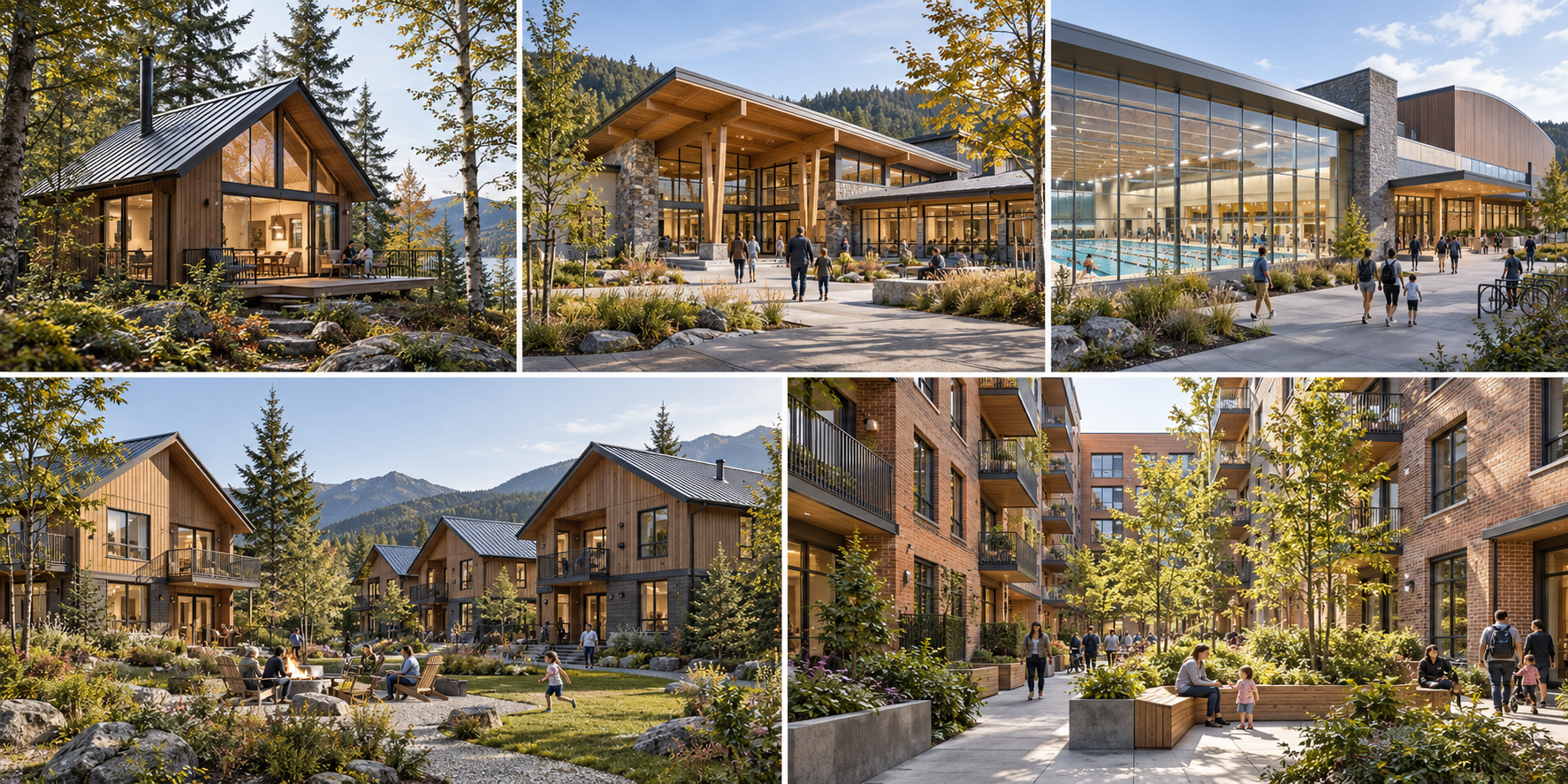
Computing and useful heat, designed around the needs of each place.
AI-generated concept illustrations — potential applications, not approved or completed projects.
AI-BTU brings together building-integrated computing, useful heat and a system information hub in development: the AI-BTU Log Book. Our Québec pilot will help test this approach for future housing projects.
PROJECT POSSIBILITIES
From a rural cabin to a public athletic facility, the right system starts with the building, its community and its actual heat demand.
CONCEPT / POTENTIAL APPLICATION
Explore compact computing hubs with heat recovery for space heating and hot-water preheating, subject to connectivity, power and year-round cooling.
CONCEPT / POTENTIAL APPLICATION
Assess how local computing and recovered heat could support shared public spaces and their daily operating needs.
CONCEPT / POTENTIAL APPLICATION
Study recovered heat for pool water, showers and suitable building systems; cooling and refrigeration interfaces require project-specific engineering.
CONCEPT / POTENTIAL APPLICATION
Explore whether computing income and shared heat recovery could help reduce housing operating costs in communities with staff accommodation needs.
CONCEPT / POTENTIAL APPLICATION
Assess projects where computing revenue and useful heat could contribute to affordability, alongside an independently validated housing and financing plan.

AI-GENERATED CONCEPT / POTENTIAL APPLICATION
Explore recovered computing heat to help meet greenhouse heating needs and support year-round local food production. Crop requirements, winter heat demand, lighting, humidity control and backup heating must be assessed for each project.
Each application requires a feasibility study. Heat demand, compute contracts, site permissions, data governance and operating economics determine whether the model fits.
01 — OUR APPROACH
Provide useful computing capacity through a compact hub designed to integrate with the building.
Explore how heat from liquid-cooled equipment can serve building needs, from space heating to hot water.
Investigate how computing revenue and heat reuse can contribute to more affordable, efficient housing.
AI-BTU LOG BOOK / IN DEVELOPMENT
A dedicated computer beside the heat exchanger, designed to bring system information together in one place. The AI-BTU Log Book is being developed to connect computing activity, heat recovery and building performance over time.
The aim: help owners and project teams understand useful heat, operating performance and the system’s contribution to housing costs. The pilot will determine what can be measured and reported reliably.
02 — THE FIRST CHAPTER
Our Québec residential pilot brings building design, computing and heat recovery into one project. The goal is to model, measure and refine the concept before considering broader applications.
Research & design stageModel. Measure. Refine.
03 — A CANADA-WIDE VISION
Our first pilot is in Québec. Our Canada-wide vision combines useful GPU computing, recovered heat and housing with provincial and national data sovereignty and a more resilient network of local hubs.
We envision municipalities owning affordable housing, with GPU computing revenue contributing to project financing and operating costs. Recovered heat could serve space heating and domestic hot-water preheating.
We are exploring compact remote computing hubs integrated with local buildings. Each project would be assessed for connectivity, power supply, useful heat demand and year-round cooling before development.
Our goal is to offer computing and data storage in Canada, with clearly defined ownership, access controls and control of encryption keys. Hosting location, operators, backups and external services must all be assessed against each client’s provincial and national data-governance requirements.
We are exploring a network of smaller hubs across regions, with suitable databases replicated between authorised sites. Independent backups, redundant power and connectivity, and tested recovery can reduce reliance on a single location and help services continue when one hub is unavailable.
The Morin-Heights pilot will help test the model. Heat contribution, net computing revenue, financing capacity and scalability remain to be validated; outcomes will depend on each project.
Canada’s Sovereign AI Compute Strategy prioritises domestic computing capacity and safeguarding Canadian data and intellectual property. AI-BTU’s proposed local-hub approach aims to contribute to those objectives through distributed infrastructure and useful heat recovery.
Federal strategy (English) · Stratégie fédérale (français)
This is a development goal, not a currently operating multi-site service or a claim of federal endorsement. Canadian hosting alone does not establish sovereignty; governance, security, authorised replication and recovery must be validated for each deployment.
04 — SERVICES & PARTNERSHIP OPTIONS
AI-BTU helps municipalities, housing providers and private owners plan projects that combine useful computing, heat recovery and building needs. Choose support for one stage or a coordinated path through development.
Each project receives a tailored proposal based on its scale, goals and service requirements.
AI-BTU Log Book is our system information hub in development. Pilot findings will guide future monitoring, reporting and project support.
Environmental benefits: recovered heat can reduce purchased heating energy. Potential carbon incentives would be assessed for each project, subject to eligibility, an applicable methodology and independent verification.
Discuss your project05 — PARTNERS
We are developing collaborations in research, building design, computing and housing. Confirmed partners and their roles will be introduced here as participation and public recognition are agreed.
Discuss a collaboration06 — THE TEAM

Leads AI-BTU, sets priorities and approves project decisions and external commitments.

Supports research, funding reviews and preparation for decisions in English and French.
These are AI support roles being connected, not a directory of hired professionals or confirmed research partners. Eric remains responsible for decisions.
LET’S BUILD THE NEXT CHAPTER
We welcome conversations with researchers, engineers, housing organizations and technology partners.
Based in Squamish, British Columbia.
Pilot in Morin-Heights, Québec.